Two-Dimensional Thin Layer Chromatography (2D-TLC): Principle, Procedure, and Applications
A complete guide on Two-Dimensional Thin Layer Chromatography (2D-TLC) — including principle, requirements, detailed step-by-step procedure, applications, troubleshooting, and educational insights. Perfect for students and educators in biochemistry and biotechnology.
PROTOCOLS
Dr. Mainak Mukhopadhyay
10/30/20251 min read
Introduction
Two-Dimensional Thin Layer Chromatography (2D-TLC) is a powerful analytical technique used to separate complex mixtures of compounds — especially biomolecules like amino acids, lipids, and nucleotides — that cannot be adequately resolved in a single-dimensional TLC run.
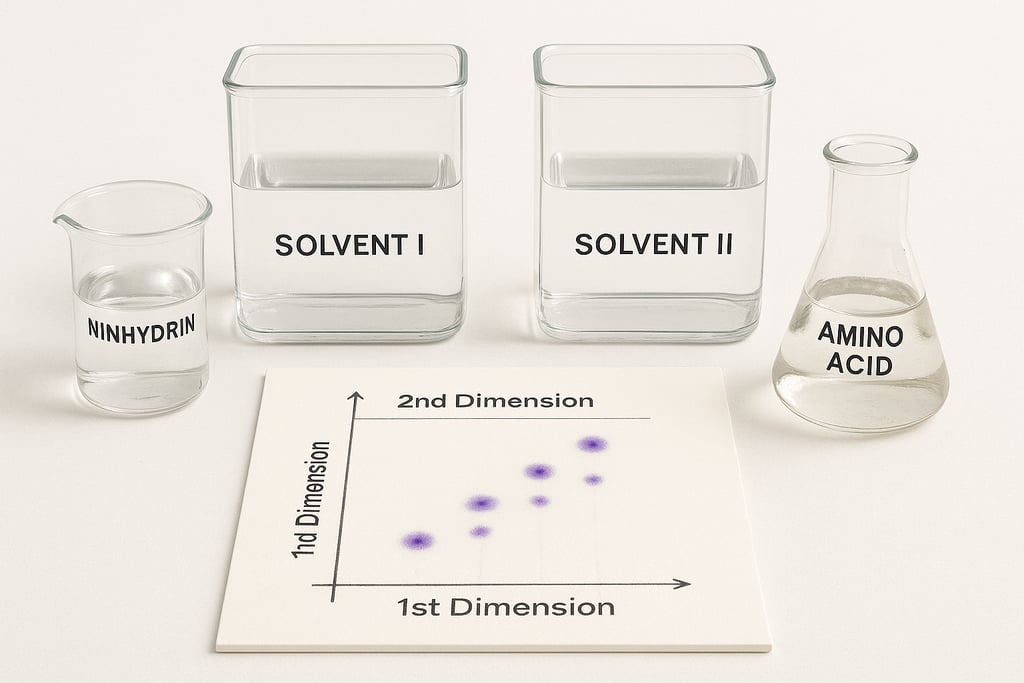
Unlike standard TLC, which develops the plate in one solvent system, 2D-TLC uses two different solvent systems in orthogonal directions. This improves the separation efficiency and helps in identifying compounds that might co-migrate in a one-dimensional setup.
This method is widely used in biochemical research, food chemistry, plant metabolite profiling, and forensic analysis, making it a versatile and essential practical for students.
Principle of 2D-TLC
The principle is based on differential partitioning of compounds between a stationary phase (usually silica gel) and two mobile phases (two solvent systems) applied sequentially in perpendicular directions.
Each compound travels a characteristic distance depending on its polarity and affinity toward each solvent system. When developed twice using two distinct solvents, each compound ideally occupies a unique position on the plate, forming a two-dimensional spot pattern that enhances resolution and identification accuracy.
Reagents and Chemicals Required
Preparation of Solvent Systems
Ensure both solvent mixtures are well-mixed and freshly prepared before use. Filter to remove impurities.
Detailed Procedure for 2D-TLC
Detailed Procedure for 2D-TLC
Principle Behind Each Step (Quick Recap)
Sample spotting: Ensures accurate and consistent sample loading.
First development: Separates compounds based on polarity in Solvent I.
Second development: Orthogonal separation using Solvent II enhances resolution.
Visualization: Ninhydrin reacts with amino acids to form colored complexes for detection.
Optimization Tips
Use freshly prepared solvent systems for consistent results.
Avoid touching the TLC surface with bare hands — oils may interfere with migration.
Control humidity to prevent irregular solvent flow.
Always use volatile, pure solvents for better reproducibility.
Allow complete drying between the two developments.
Applications of 2D-TLC
Separation and identification of amino acids and peptides.
Lipid profiling in biological membranes.
Detection of nucleotides and carbohydrates in complex mixtures.
Pharmaceutical quality control and purity checks.
Plant metabolite fingerprinting.
Explore
Stay updated with biotech insights and research.
Connect
Discover
m.mukhopadhyay1212@gmail.com
+91-8777294577
© 2025. All rights reserved.